Intelligence,
the way nature built it.
Big intelligence on Tiny power. An AI Engine inspired by the brain, Switches on only what each task needs.
Research
Perspective paper published, Oct 2026
- 2
PrototypeNow
Voice-command testbed on budget phones
- 3
Developer preview
First design partners, 2027
- 4
Pilots
Measured results published per device and per user group
The brain runs general intelligence on 20 watts.
86B
neurons in the human brain
~20 W
to power all of it, less than a light bulb
50,000×
the brain’s power budget, for every megawatt a data centre draws to serve frontier AI
And unlike the brain, today’s models stop learning the moment they ship.
AI scales up.
It doesn’t scale down.
Scaling hits limits
Frontier AI needs GPU clusters, power and capital that few can afford.
Edge is underserved
Phones and wearables have little power or memory. Big models don’t fit.
Models stop learning
Deployed models can’t adapt to each user, and naive updates erase old skills.
Most phones are left out
On-device AI is tuned for flagship phones and a handful of languages.
One engine that keeps learning on the device.
The 86b SDK ships one compact base model to Android apps and edge devices, then personalises it on every phone. It is designed to learn each user locally, keep what it already knew, and stay inside a budget phone’s power and memory limits.
Designed toAdapts in minutes
To a new user, device or setting from a handful of examples.
Remembers
Earlier skills stay intact while new ones are learned, like memory consolidation in the brain.
Computes sparsely
Activates only the parts each input needs, cutting energy and latency.
Stays private
Data and learning never leave the phone.
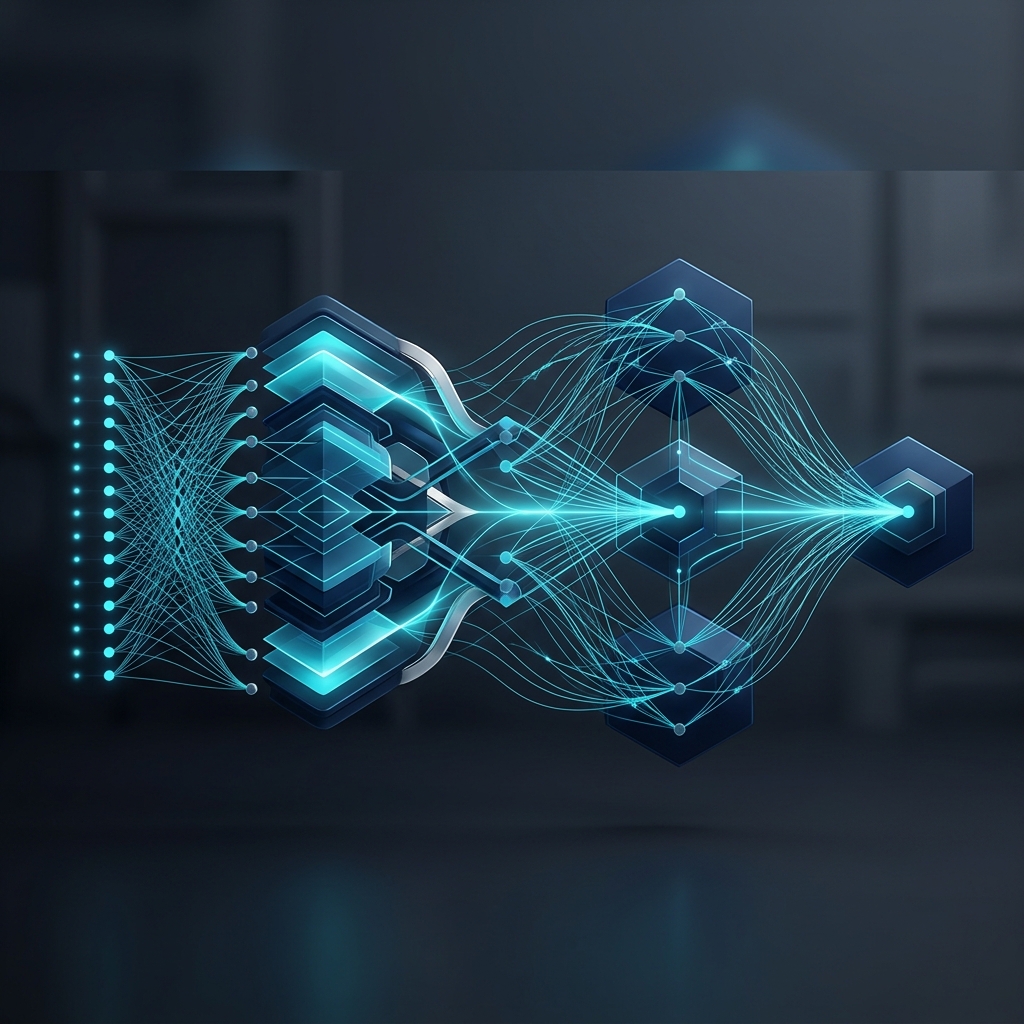
Designed for
$100–180 Android phones
Targeting CPU, GPU and NPU via LiteRT, ExecuTorch and ONNX Runtime. Neuromorphic chips later.
Why not just fine-tune on the phone?
vs. fine-tuning on device
Naive updates overwrite what the model knew. A separate fast adapter learns the user while the slow learner keeps shared knowledge intact.
vs. cloud personalisation
Sending audio and sensor data to a server costs energy, bandwidth and trust. Here the data and the learning never leave the phone; only aggregate metrics do.
vs. flagship-only on-device AI
Most on-device assistants target high-end chips and a few languages. The 86b SDK is sized for $100–180 phones and tested on regional languages, accents and noise first.
Learn fast from each user. Consolidate slowly into shared knowledge.
The engine we’re building separates what a model knows from how it adapts, so each device can learn quickly without overwriting shared knowledge.
Inference path
Input stream
Audio and sensor data on the device
Predictive encoder
Learns from unlabelled input
Slow learner
Sparse experts, few active per input
Prediction
Output plus a confidence score
Consolidation
Replay when idle or charging
Episodic memory
Compact buffer of recent examples
Fast learner
Small adapter that updates per user
Uncertainty gate
Adapts only when the signal is reliable
Adaptation loop
Inference path
Input stream
Audio and sensor data on the device
Predictive encoder
Learns from unlabelled input
Slow learner
Sparse experts, few active per input
Prediction
Output plus a confidence score
Adaptation loop
Uncertainty gate
Adapts only when the signal is reliable
Fast learner
Small adapter that updates per user
Episodic memory
Compact buffer of recent examples
Consolidation
Replay when idle or charging
Complementary fast and slow learners
A slow learner holds general knowledge and changes rarely. A small, low-rank fast adapter updates online from each user. Day-to-day learning touches only the adapter, so shared knowledge is protected from catastrophic forgetting.
Sparse conditional computation
The slow learner is a set of compact experts with a lightweight router that activates only a few per input, cutting compute per inference and limiting what each update can disturb.
Predictive self-supervised encoding
Inspired by predictive coding, the encoder learns to predict masked or future segments of its input, so the device learns structure from unlabelled audio and sensor streams.
Uncertainty-gated adaptation
Every prediction carries a calibrated confidence score. The fast learner updates only on reliable signals, such as a user confirming or correcting a result, so it never learns its own mistakes.
Episodic memory and consolidation
A bounded on-device buffer replays recent examples while the phone is idle or charging, moving stable improvements into the slow learner, much like memory consolidation during rest.
Five brain principles, each tied to a metric we will measure on real phones.
Every result we publish will be reported alongside its cost: accuracy together with forgetting, energy, latency and memory, measured with an external power monitor on low-cost hardware.
Learning stays on the phone.
The cloud only ships models.
86b SDK
Slow learner
Sparse experts
Fast adapter
Per-user updates
Uncertainty gate
Decides when to learn
Episodic memory
Bounded, on-device
Consolidation
When idle or charging
Energy monitor
mJ, latency, memory
Runtimes: LiteRT · ExecuTorch · ONNX Runtime
CPU, GPU and NPU today; neuromorphic chips later
Pre-training pipeline
Base models from public data
Model registry and OTA
Signed releases to devices
Developer dashboard
Aggregate metrics only
Federated learning
Opt-in, later phase
Raw data never leaves the device
Base models and signed updates flow down to devices. Only anonymous, aggregate performance metrics flow up. Architecture is tentative and will evolve through the pilots.
Voice commands that learn each speaker.
Voice recognition fails most on regional accents, code-mixed speech and noisy rooms: the everyday reality for billions of users. Our first testbed is designed to fix that on the phone itself.
Starts from one compact base model
Adapts to each speaker over a few uses, on the phone
Keeps every earlier command; no audio leaves the device
One demo to prove every claim: on-device learning, no forgetting, low energy, budget phones. Design partners will see it first.
Use 1
“Papa ko call karo”
Concept illustration of the planned demo
Tested where conditions are hardest.
Where on-device learning pays off first.
Health and wellness apps
Private, personalised readings on budget phones
Wearable and IoT makers
AI within tight battery and memory limits
Phone makers and chip vendors
Assistants that learn the user locally
Enterprise and fintech apps
Personalisation without sending data to the cloud
Industrial and agritech edge
Models that adapt to new sites and sensors
Intelligence per watt.
Our perspective paper defines the problem, the approach and the evaluation standard we will report results against: falsifiable hypotheses, an open protocol that makes energy and forgetting first-class metrics, and a benchmark grounded in real-world, multilingual conditions.
Intelligence per Watt: A Brain-Inspired Framework for Continual On-Device Learning on Low-Cost Hardware
Munish Dhiman · 86b.ai
The brain supports general intelligence with roughly 86 billion neurons on about 20 watts. We argue the next gains in practical AI will come from systems that learn continually, compute sparsely and adapt to individual users on the devices they already own.
Written by Munish Dhiman, founder of 86b.ai. About the team →
Hypotheses we will test
Forgetting
The fast and slow design forgets less than naive fine-tuning and elastic weight consolidation at equal size and memory.
Energy
Sparse computation cuts measured energy per inference and per update on low-cost phones, without losing accuracy.
Data efficiency
Predictive self-supervised pre-training reduces the labelled examples needed to reach a target accuracy.
Equity
On-device personalisation narrows the gap between best- and worst-served speakers, languages and device tiers.
Reliability
Uncertainty-gated updates cause fewer accuracy regressions than ungated adaptation.
Evaluation protocol
Measured on at least three low-cost Android phones across chipset families, reported per device and per user subgroup so no population is hidden in an average.
A real-world benchmark
Language
Multiple regional languages, lower-resource ones and code-mixed speech
Speaker
Regional accents, age groups, gender balance
Environment
Quiet rooms, street noise, households, markets, vehicles
Device tier
Low-cost, mid-range and flagship phones across chipsets
Collected with informed consent, ethics committee approval and fair compensation, in line with applicable data protection laws.
86 billion neurons. 20 watts. Our benchmark.
Sign up for the early preview.
The 86b SDK isn’t available yet. Early access means you hear first when the developer preview opens, can apply to the pilot programme, and get the measured results as we publish them. We’re especially keen to hear from:
Design partners
Apps that need on-device personalisation for multilingual users.
Researchers
Continual learning, efficient AI and computational neuroscience.
Hardware partners
Edge and neuromorphic chip makers.
Also from 86b.ai: enterprise AI services for private GenAI, automation, vision and digital twins.
Explore services